NASA’s Next Mars Helicopter Has 36 Blades
Ingenuity was the Wright Flyer moment — 1.8kg, 4 feet across, 2 rotors with 2 blades each, designed for 5 flights over 30 days. It did 72 flights over almost 3 years until it lost a blade on landing in January 2024.
Everything now is built on what it proved, but the next generation is a completely different class of aircraft.
- The Mars Chopper – the one with 36 blades
This is JPL and AeroVironment’s flagship follow-on. Think SUV-sized, not drone-sized. About 20 times heavier than Ingenuity.
Instead of a single coaxial stack, it’s a hexacopter. 6 arms, each with a rotor stack that has 6 blades. 6 x 6 = 36 blades.
Why that looks weird for Earth but makes perfect sense for Mars:
Mars atmosphere is less than 1% as dense as Earth’s. You can’t get lift by just spinning bigger rotors faster, because your blade tips go supersonic and lose efficiency. Ingenuity already had to spin at ∼2,400 rpm, about 8x a terrestrial helicopter.
The Chopper solves it with lots of small, highly-loaded blades sharing the load. More blades = more total lifting area without making any single rotor huge. JPL has been testing these new carbon airfoils in vacuum chambers at Ames and Langley past Mach 1 tip speeds, which is unavoidable on Mars.
What it can actually do that Ingenuity couldn’t:
Carry 5kg+ of science payload instead of just a camera — spectrometers, sampling arms, subsurface radar
Fly up to 3km per flight, with multiple flights per Martian day
Range of ∼10km per sol vs Ingenuity’s best of ∼700m
True autonomous exploration, scouting for sample return or human landing sites, not just being a Perseverance sidekick
- Skyfall and the new way to get there
Skyfall is less about the helicopter itself and more about how we deliver them. Right now you need a rover or lander to carry the helicopter down.
The Skyfall concept is to skip the lander entirely. You build a small aeroshell that enters directly, and at altitude it opens up and just drops a swarm of small helicopters. They spin up in freefall and fly away under their own power.
That would let NASA put 4-6 helicopters in different regions for the price of one traditional mission. For a planet with Valles Marineris, lava tubes, and polar ice, that distributed approach is huge.
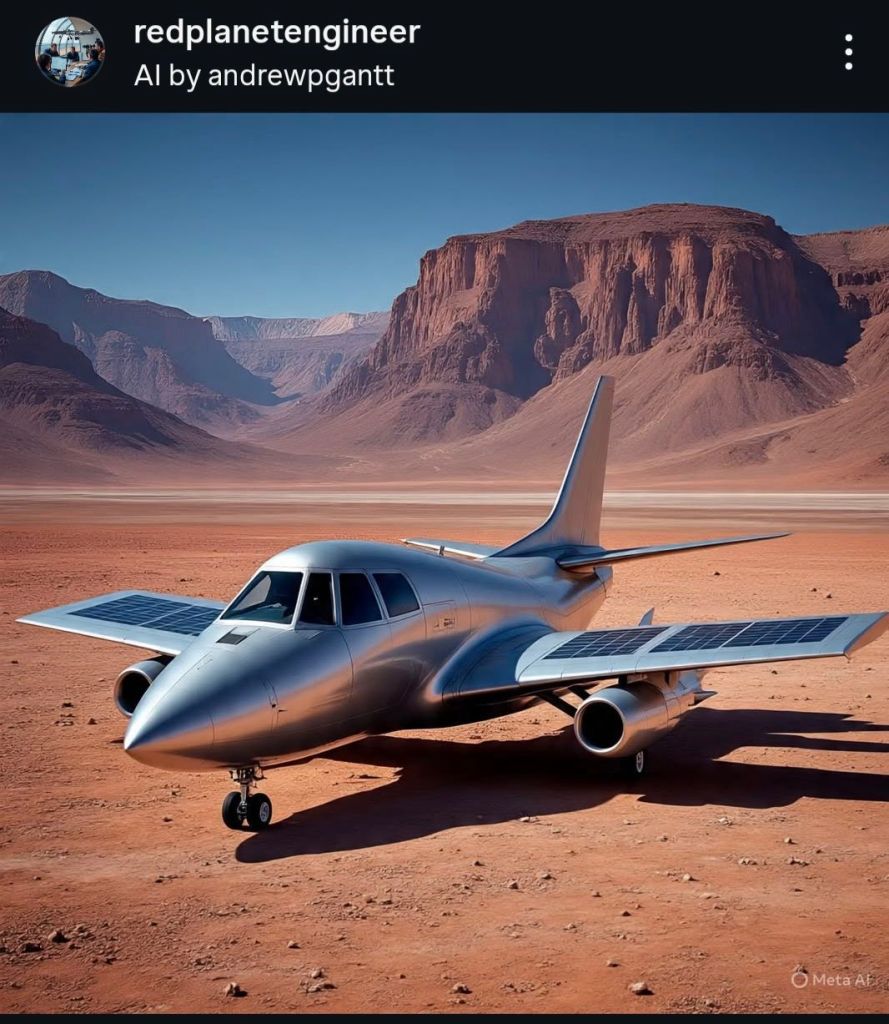
There are other parallel tracks too — JPL’s Mars Science Helicopter is a middleweight between Ingenuity and Chopper, around 20-30kg, and commercial groups are looking at fixed-wing/ VTOL hybrids that use Mars’ high-speed winds.
The big shift from Ingenuity is this: Ingenuity proved powered flight is possible. Chopper and Skyfall are trying to make flight useful — heavy lift, long range, and cheap deployment so aircraft become the primary way we explore Mars, not the exception.
Want to dig into the rotor aero — why they went with 6 blades per hub vs. a wider 2-blade, or how they handle that transonic tip stall problem?